
Income Protection Insurance Tax Deductions: How to Claim in Australia (FY 2026 Guide)
Income protection insurance is a crucial tool for safeguarding your income in case you’re unable to work due to illness or injury. But did you know that the premiums you pay for income protection insurance can be claimed as a tax deduction in Australia? Understanding how to claim these deductions could help you reduce your taxable income and save on taxes.
With the end of the financial year (June 30) fast approaching, now is the time to learn how to make the most of these deductions. This guide will walk you through everything you need to know about income protection insurance tax deductions for FY 2026.
Tax Deductibility Rules for Income Protection Insurance (ATO Guidelines)
The Australian Taxation Office (ATO) allows taxpayers to claim deductions for income protection insurance premiums. The good news is that these premiums can reduce your taxable income, which means you’ll pay less tax overall.
Income protection insurance provides financial support when you can’t work due to illness or injury. In Australia, the ATO considers these premiums deductible if you hold a personal income protection coverage policy. However, if your policy includes other types of insurance, like life insurance or trauma insurance, only the portion that covers income protection can be deducted.
It’s important to ensure that you are claiming for the correct insurance type. Life insurance and trauma insurance are not deductible, so make sure you separate the income protection component from these others to avoid any confusion when filing your taxes.
What’s Deductible vs. Non-Deductible: Income Protection vs. Life Insurance
When it comes to claiming deductions, not all insurance policies qualify. Here’s a breakdown of what you can and cannot deduct:
Income Protection Insurance: The ATO allows you to deduct premiums paid for income protection insurance. This applies whether you pay your premiums monthly or annually.
Life Insurance: Premiums for life insurance are not deductible. Even if your life insurance is part of the same policy as income protection, the ATO requires you to separate the deductible portion from the non-deductible part.
Trauma Insurance: Similar to life insurance, trauma insurance is also not deductible. If your policy includes trauma coverage, you’ll need to ensure that you’re only claiming the income protection portion.
If you’re not sure how your policy is structured, contact your insurance provider for clarification. Keeping these details clear will help ensure you’re claiming the correct amount.
How to Claim: Tax Return Step-by-Step
Claiming a deduction for income protection insurance premiums is straightforward, but you must keep track of your premiums and follow the steps carefully to ensure you get the full deduction.
Here’s how to claim income protection insurance premiums on your tax return:
Step 1: Gather Your Premium Statements Collect the premium statements provided by your insurer. These documents should show how much you’ve paid for income protection insurance over the financial year. It’s important to have accurate records so you can claim the correct amount.
Step 2: Complete Your Tax Return When filling out your tax return, look for the section where you can claim deductions. This section is usually under “Other deductions.” You’ll need to enter the total premium you’ve paid for your income protection insurance.
Step 3: Claim the Deduction Enter the deductible amount into the appropriate section of your tax return. The ATO allows you to deduct the full amount you’ve paid in premiums for that year, so long as the policy only covers income protection.
Step 4: Submit Your Tax Return After completing your tax return, submit it to the ATO. Once processed, the tax deduction for your income protection insurance premiums will lower your taxable income, potentially leading to a tax refund or reduced taxes owed. If you’re unsure about the process, seeking professional financial advice can help ensure you’re not leaving money on the table.
Premium Payment Structures: Annual vs. Monthly Impact
The frequency at which you pay your premiums can affect how you claim them. Both annual and monthly payments are deductible, but there are some differences in how they impact your tax return.
Annual Payments: If you choose to pay your premiums annually, you can claim the full amount for that year’s premium in your tax return. This can be helpful for those who want to claim a larger deduction in one go and might find it easier to manage. The main advantage of annual payments is that you only need to keep track of a single payment.
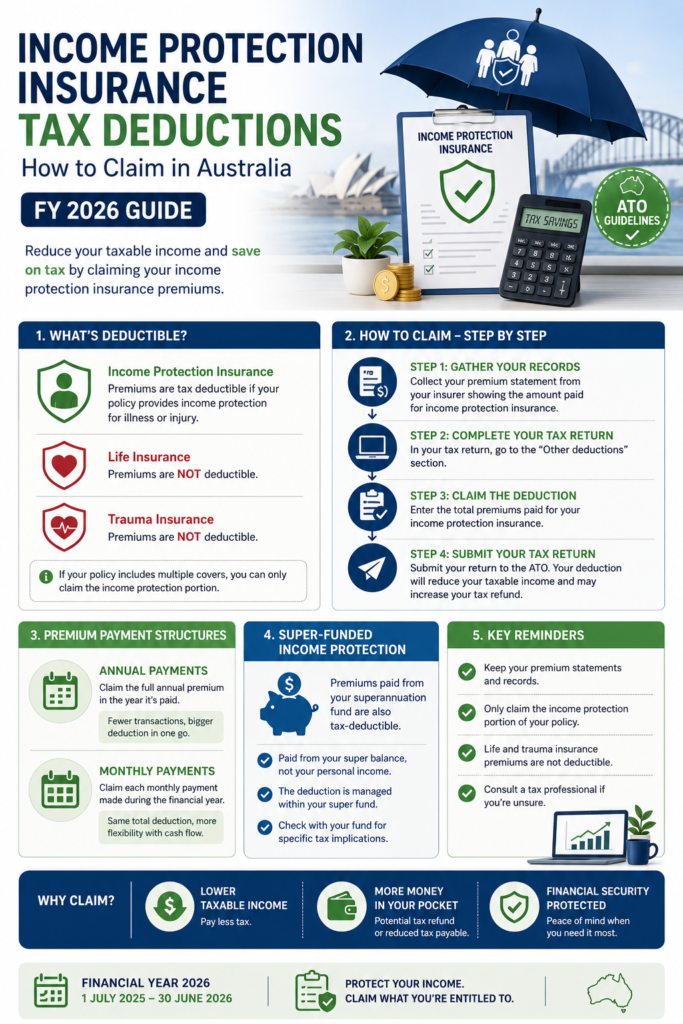
Monthly Payments: If you prefer to pay monthly, you can still claim the deduction for each payment made within the financial year. While the deductions are spread out over the year, the total tax deduction will be the same as paying annually. The right choice often comes down to your cash flow situation and how you prefer to manage your budget throughout the year.
Super-Funded Income Protection: Different Tax Treatment
Some Australians choose to pay for income protection insurance through their superannuation fund. This has its own set of tax rules that you need to be aware of.
Tax Deductibility: Income protection insurance premiums paid through your superannuation fund can also be tax-deductible. However, the payments are made from your super balance, and this affects how the deduction is treated on your personal tax return.
Super Contributions: When premiums are paid from your super, the cost of the insurance is typically deducted from your super balance, rather than your personal income. This means that you’re not directly claiming the deduction in your tax return. Instead, your super fund handles the tax aspects.
While this can be a convenient way to pay for your premiums, keep in mind that it reduces your superannuation balance, which could significantly impact your retirement savings over the long term.
Different Tax Treatment: Super-funded income protection insurance is subject to different tax treatment. If you’re considering this option, it’s important to weigh the potential benefits against the impact it may have on your retirement savings.
MC’s Accounting + Insurance Integrated Service
MC’s accounting and insurance integrated service works together to help you maximize your tax deductions while ensuring you have the best income protection coverage. By integrating accounting services with your insurance needs, you can simplify your finances and make the most of your tax opportunities.
With expert guidance, MC’s team ensures that your insurance premiums are correctly structured to reduce your taxable income and maximize your coverage. Whether you’re paying premiums annually or through your superannuation fund, they’ll help you navigate the process with ease.
FAQs
Yes, self-employed individuals in Australia can claim deductions for income protection insurance premiums, just like employees. However, you must ensure that the insurance policy covers only income protection and not other types like life insurance or trauma insurance.
Retirees who still receive income and pay income protection insurance premiums can claim the deduction. However, if you’re receiving a pension or income solely from superannuation, you may not be eligible to claim a deduction on premiums paid for income protection insurance.
Yes, if you’ve arranged for your income protection insurance premiums to be paid from your superannuation, you can still claim a deduction. However, it’s important to note that the ATO treats these premiums differently. The premiums are paid from your super balance, and while you can claim the deduction, it reduces your superannuation balance, potentially affecting your retirement savings.
If your policy includes both income protection insurance and other forms of insurance, like life or trauma insurance, only the premiums for the income protection coverage are deductible. You will need to ensure that your insurance provider can provide a breakdown of premiums by coverage type so you can accurately claim the deductible portion.
Company directors and employees of small businesses in Australia can claim deductions for income protection insurance premiums if the insurance is for personal income protection. However, if the premium covers business-related purposes, like replacing business income, the premium may need to be treated as a business expense.
Regardless of whether you pay monthly or annually, the total premium amount remains the same and is deductible in the year it’s paid. However, if you pay monthly, you’ll need to ensure that each monthly payment is claimed on your tax return for that specific year. Annual payments are simpler as you can claim the entire amount at once, but both methods ultimately provide the same tax savings.
If your spouse pays for their own income protection insurance, they are eligible to claim the deduction on their individual tax return. However, if you’re paying for the premiums on behalf of your spouse, you cannot claim the deduction unless the insurance policy is in your name and relates directly to your income protection.
While income protection insurance premiums can reduce your taxable income, they do not directly affect the Medicare levy or surcharge. The Medicare levy is based on your taxable income, but insurance premiums, including income protection, do not reduce the Medicare levy.
Higher-income earners in Australia can benefit significantly from claiming income protection insurance premiums. Since income protection premiums maximize your tax savings by reducing your taxable income, those in higher tax brackets (like the 37% or 45% tax bracket) can save a greater percentage on their taxes.
If you have a combined policy that covers income protection along with life or trauma insurance, you can only deduct the income protection portion. Insurance providers can usually break down the premiums for each part of the policy, so it’s important to ensure you’re only claiming the deductible income protection portion.
Conclusion
Income protection insurance tax deductions are a valuable tool for reducing your taxable income and saving on taxes. By understanding the ATO’s guidelines and how different payment structures and super-funded options affect your claims, you can make the most of these deductions. As the end of the financial year approaches, now is the time to review your income protection insurance and ensure you’re ready to claim before the June 30 deadline.
With the right planning and professional advice from MC’s integrated services, you’ll be able to make informed decisions and maximize your tax savings. Reach out to the MC Mortgages team today to ensure your insurance and tax strategy are working together for your financial benefit.