
Income Protection for Self-Employed in Brisbane: Coverage Options & Costs (2026)
Income protection is a vital financial safety net for self-employed individuals in Brisbane. Unlike employees, the self-employed face unique challenges when it comes to securing adequate income protection. With fluctuating incomes and limited access to employer benefits, self-employed workers must take proactive steps to safeguard their financial future.
This article delves into income protection options tailored for the self-employed in Brisbane, helping business owners understand the coverage, costs, and strategies that can best suit their needs in 2026.
Understanding Income Protection for the Self-Employed
Self-employed individuals in Brisbane face particular challenges in securing income protection. Unlike employees, they do not have the luxury of sick leave, paid holidays, or employer-provided benefits. Therefore, securing income protection is even more crucial to protect their livelihood if they are unable to work due to illness or injury.
Our Borrowing Protection services are specifically designed to help self-employed individuals navigate these challenges and find the right coverage for their situation.
Challenges for Self-Employed:
Irregular Income: Self-employed workers often experience unpredictable income streams, which makes it harder to determine the appropriate level of coverage.
Income Verification: Underwriting income protection policies often requires proof of income, which can be more difficult for contractors or freelancers who have fluctuating earnings.
However, despite these challenges, it’s crucial for self-employed individuals in Brisbane to take the necessary steps to secure income protection. Without a steady paycheck from an employer, business owners and freelancers are especially vulnerable if an accident or illness prevents them from working.
This vulnerability can also directly affect your borrowing capacity, making it harder to secure home or investment loans when income is disrupted.
To overcome these challenges, understanding the types of coverage available and how to verify income is essential for self-employed individuals looking to secure income protection.
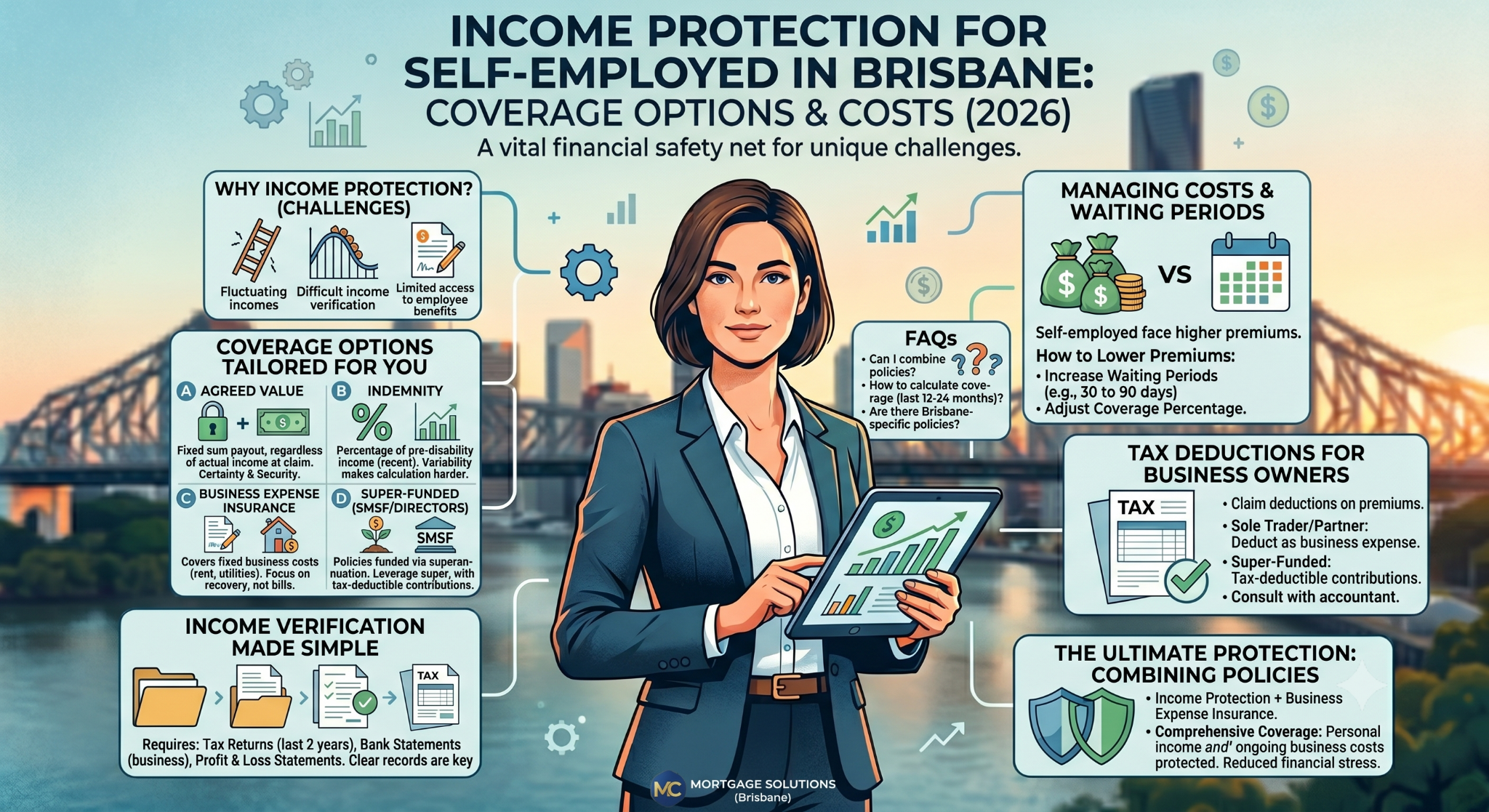
Types of Income Protection Coverage for the Self-Employed
There are several types of income protection policies available for self-employed workers in Brisbane. Each offers different features to cater to the specific needs of business owners, freelancers, and contractors.
Indemnity Income Protection: This policy covers a percentage of your pre-disability income. However, it can be tricky for self-employed individuals, as the insurer will use recent income to calculate the benefit. The variability of income can make this coverage harder to determine and more expensive.
Agreed Value Income Protection: This policy ensures that you are paid the agreed-upon sum regardless of your actual income at the time of the claim. It’s a good choice for the self-employed, as it provides more certainty and security in the event of an injury or illness.
Business Expense Insurance: This policy can help cover the fixed costs of your business, such as rent and utilities, in case you are unable to work. While this doesn’t directly cover your income, it can keep your business running while you focus on recovery.
Super-Funded Options for Directors: For business owners who have superannuation, some insurers offer policies that can be funded through your superannuation account. This is an attractive option for directors who want to make the most of their superannuation fund to cover income protection. Learn more about how a Self-Managed Super Fund can be structured to support your income protection strategy.
Understanding Income Verification for Self-Employed Individuals
Income verification is a key aspect of obtaining income protection for self-employed individuals. Unlike employees, self-employed workers don’t have regular pay slips, which can make the process of proving income more complicated.
How to Verify Income for Underwriting:
Tax Returns: Insurers typically require tax returns for the last two years to assess your income and financial stability.
Bank Statements: In some cases, business bank statements may also be requested to confirm your earnings.
Profit and Loss Statements: Self-employed individuals may need to provide their profit and loss statements, particularly if they are freelancers or contractors with inconsistent incomes.
The key to a successful income protection application is presenting clear and honest income records. Doing so ensures that the insurer can provide an accurate premium quote and adequate coverage based on your earnings. Our accounting and financial services team can assist you in preparing the documentation needed for a smooth application process.
Waiting Periods and Premium Costs for Self-Employed
Self-employed individuals often face higher premiums for income protection due to the increased risk and uncertainty of their income. However, it’s crucial to compare policies and understand what the costs entail.
Premium Costs:
Income Variability: Since the self-employed typically earn more variable incomes, insurers may charge higher premiums to cover the potential risk.
Higher Risk: Self-employed individuals often lack the safety net of paid leave or group benefits, making insurers more cautious about underwriting their policies. This can lead to higher premiums.
Waiting Periods:
Income protection policies for self-employed workers often have waiting periods ranging from 30 days to 90 days. A shorter waiting period can result in higher premiums, but it ensures that the policyholder can access their benefits sooner in case of illness or injury.
How to Lower Premiums:
Increase Waiting Periods: Opting for a longer waiting period can lower premiums. However, this means you’ll need to rely on savings or other sources of income until your benefits begin.
Adjust Coverage: Reducing the percentage of your income covered can also help reduce premiums. However, it’s essential to ensure the coverage amount is still sufficient for your needs.
There are also broader financial strategies that may help you manage costs. For instance, understanding 5 reasons you may be able to get a lower interest rate on associated loans can free up cash flow to comfortably afford your protection premiums.
Tax Deductions for Self-Employed Business Owners
Self-employed individuals in Brisbane can often claim tax deductions on their income protection premiums. This can help reduce the overall cost of the policy and make it more affordable. The Australian Tax Office (ATO) allows self-employed business owners to claim deductions for insurance policies that protect against the loss of income due to illness or injury.
How Tax Deductions Work:
Business Expense: If you’re a sole trader or a partner in a business, you can deduct the premiums from your taxable income as a business expense.
Superannuation Contributions: Some income protection policies can be funded through superannuation. In such cases, the premiums may be tax-deductible under superannuation contribution rules.
It’s always best to consult with a professional through our accounting and financial services to fully understand how income protection premiums may be claimed as tax deductions for your specific situation. Additionally, understanding positive and negative gearing strategies can further optimise your overall tax position as a self-employed business owner.
Combining Income Protection with Business Expense Insurance
Business expense insurance can complement income protection policies for the self-employed, particularly if you have ongoing business expenses that still need to be paid if you’re unable to work. Combining both insurance policies can ensure that your personal and business finances are covered in case of illness or injury.
Why Combine Both:
Comprehensive Coverage: While income protection covers your lost earnings, business expense insurance covers your ongoing business costs such as rent, utilities, and salaries. This combination ensures your entire financial situation is protected. Explore our full range of investment and financial services to build a comprehensive financial safety net.
Reduced Financial Stress: Having both policies in place means you don’t need to worry about paying bills or maintaining your business while you focus on recovering. It also helps avoid the need to consolidate debt due to financial pressure during a recovery period.
FAQs
Income protection replaces your lost income if you’re unable to work due to illness or injury. On the other hand, business expense insurance covers your business’s fixed costs, such as rent, utilities, and employee salaries.
When calculating income protection coverage, self-employed individuals need to estimate their average monthly income over the past 12–24 months. This can include income from contracts, freelance work, and business revenue.
Yes, contractors and freelancers are eligible for income protection in Australia. However, since their income is often irregular, they may need to provide a detailed breakdown of their earnings, including tax returns and bank statements, to prove their income to the insurer.
Yes, many insurers offer tailored income protection policies for self-employed business owners in Brisbane. These policies can include superannuation-funded options or business expense insurance.
Waiting periods typically range from 30 to 90 days for income protection policies for self-employed individuals. A shorter waiting period allows you to receive benefits sooner, but the premiums will be higher.
There are several ways self-employed individuals can reduce their income protection premiums. They can increase the waiting period, adjust the coverage amount, or combine policies such as pairing income protection with business expense insurance or superannuation-funded policies, which can also offer tax benefits.
Self-employed individuals in Brisbane can claim tax deductions for their income protection premiums as a business expense. This is allowed under ATO regulations, as long as the policy is for income protection related to business activities.
Yes, income protection is available for self-employed individuals with irregular income. Insurers will assess your income using tax returns, bank statements, and profit and loss statements to determine your eligibility and coverage.
Yes, self-employed individuals can combine income protection with other business-related policies such as business expense insurance. This combination ensures that both your personal income and business expenses are covered if you’re unable to work.
Conclusion
Income protection for self-employed individuals in Brisbane is essential for safeguarding your financial future. It can be more challenging to secure due to income verification issues and higher premiums. However, understanding the types of coverage available, the factors affecting premiums, and how to verify your income can help you make an informed decision.
In 2026, self-employed business owners can benefit from policies like indemnity, agreed value, and business expense insurance to ensure they are covered in case of illness or injury. Tax deductions and super-funded options provide additional financial flexibility for business owners.
Working with an experienced professional who understands the unique challenges of self-employed income protection can make a significant difference and that’s exactly what our team at MC Mortgage Solutions is here for. If you’re a self-employed business owner in Brisbane, make sure you’re adequately covered by choosing the right policy that suits your income, needs, and budget.