
Property Investment Tax Deductions Australia: Complete FY 2026 Checklist
For property investors in Australia, tax deductions play a crucial role in maximizing returns. As we approach the end of the financial year 2026, it’s important to understand which tax deductions you’re eligible for, particularly if you’re involved in investment properties.
Knowing these deductions not only helps you save money but also ensures that you’re compliant with tax laws. This article provides a complete checklist for property investment tax deductions, highlighting essential areas like loan interest, depreciation, capital works, and negative gearing tax benefits.
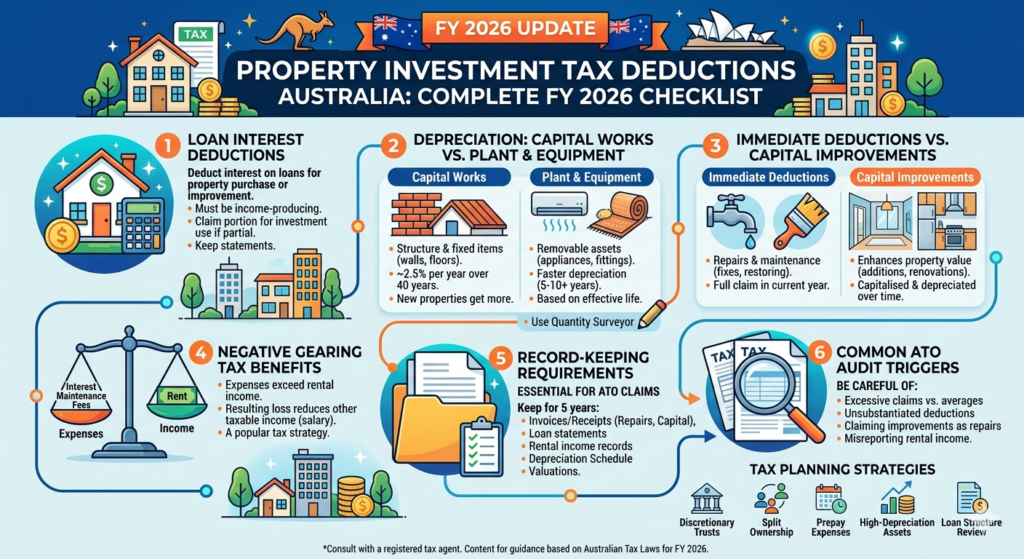
1. Loan Interest Deductions
One of the most significant tax deductions for property investors is loan interest. If you’ve taken out a loan to finance your property investment, the interest paid on that loan is generally deductible. This deduction is important because it allows you to lower your taxable income and reduce the amount of tax owed.
The loan interest deduction applies whether you’ve purchased a property outright or taken a mortgage for investment purposes by MC Mortgage Solutions. The interest cost is deductible as long as the property is used for income-producing purposes, such as rental income. This deduction applies to the entire interest paid on the loan throughout the financial year.
However, if you use part of the property for personal use, such as a holiday home, only the portion used for investment can be claimed. It’s important to keep a record of all interest payments, and ensure that the deduction aligns with the percentage of the property used for investment purposes.
For property investors, loan interest is a straightforward way to lower your taxable income, making it a key tax strategy for FY 2026.
2. Depreciation: Capital Works vs. Plant & Equipment
Depreciation is a crucial tax deduction that allows property investors to claim a reduction in the value of their property’s assets over time. Depreciation applies to both capital works and plant & equipment, each with its own rules.
- Capital Works Depreciation: This applies to the structure of the property, such as the walls, floors, and roofing. You can claim a deduction for construction costs over a period of 40 years, typically at 2.5% per year. For new properties, this can be a significant deduction.
- Plant & Equipment Depreciation: This applies to removable assets in the property, like air conditioning units, ovens, and carpets. Depreciation for these items is claimed at a much faster rate. Some assets can be depreciated over 5 to 10 years, while others may have a much shorter lifespan.
The difference between these two types of depreciation is important to understand for tax purposes. Investors should conduct a depreciation schedule to maximize these claims and reduce their taxable income. Hiring a qualified quantity surveyor can help ensure that depreciation is calculated accurately and complies with ATO requirements.
3. Immediate Deductions vs. Capital Improvements
When it comes to property investment tax deductions, there’s a distinction between immediate deductions and capital improvements. Understanding the difference can help you make the most of your tax deductions.
- Immediate Deductions: These are expenses that can be deducted in the year they are incurred. For example, repairs and maintenance costs, such as fixing a leaky roof or painting the property, can typically be claimed as immediate deductions. These costs help reduce your taxable income for the year.
- Capital Improvements: These expenses, like adding a new extension or upgrading the kitchen, are considered improvements to the property’s value. As such, they are not deductible immediately. Instead, they are capitalized and depreciated over time. This means the deduction is spread out over several years, based on the useful life of the improvements.
For tax efficiency, it’s essential to track these expenses separately. Immediate deductions are beneficial for short-term tax relief, while capital improvements can offer long-term benefits through depreciation. Keeping good records of each type of expense will help you maximize your deductions and avoid issues with the Australian Taxation Office (ATO).
4. Negative Gearing Tax Benefits
Negative gearing is a popular strategy used by property investors in Australia to reduce their taxable income. It occurs when the costs of owning and managing an investment property (including loan interest, maintenance, and depreciation) exceed the income generated by the property (e.g., rental income). The loss incurred can be offset against other taxable income, such as salary or business income, reducing the overall tax liability.
For example, if the annual expenses for a rental property, including interest and maintenance, are $20,000, but the rental income is only $15,000, the $5,000 loss can be deducted from your other income. This reduces the amount of tax you need to pay.
Negative gearing can be especially beneficial for higher-income earners, as it lowers their overall tax liability. However, it’s important to be mindful of the long-term implications, as relying on negative gearing alone may not generate significant capital growth. It’s essential to ensure that the property has the potential for future growth in value to make the strategy worthwhile.
For FY 2026, investors should carefully evaluate their properties for potential tax benefits from negative gearing while considering the long-term capital gains.
5. Record-Keeping Requirements for Tax Deductions
Proper record-keeping is essential for claiming tax deductions on your investment property. The Australian Taxation Office (ATO) requires property investors to maintain accurate records to substantiate any tax claims. Keeping detailed and organized records will not only help you maximize your deductions but also protect you in case of an ATO audit.
Here’s what you need to keep:
- Invoices and Receipts: For repairs, maintenance, and capital works. This includes receipts for work done on the property, as well as any materials purchased.
- Loan Documentation: This includes details of your mortgage, loan statements, and interest payments. Keep a copy of all loan agreements and payment receipts.
- Depreciation Schedules: If you are claiming depreciation, ensure you have a professionally prepared depreciation schedule that outlines the depreciation of both capital works and plant & equipment.
- Rental Income: Keep a record of all rental income received, including rental agreements, bank statements, and tenant details.
- Property Valuations: If you’ve had your property valued for depreciation or other purposes, keep a copy of the valuation report.
By maintaining a comprehensive record of your investment property activities, you can ensure that you claim every eligible deduction and avoid penalties during tax season.
6. Common ATO Audit Triggers for Property Investors
Property investors should be aware of common ATO audit triggers that could lead to a deeper review of their tax returns. The ATO uses sophisticated algorithms and data matching to detect discrepancies, so it’s important to ensure your claims are accurate and well-documented.
Common triggers include:
- Claiming Excessive Deductions: Claims for repairs, maintenance, or depreciation that are unusually high compared to industry averages could raise flags.
- Unsubstantiated Deductions: Failing to provide receipts, invoices, or other documentation to support claims for deductions can lead to an audit.
- Incorrectly Claiming Capital Improvements as Repairs: If you claim capital improvements as repairs to reduce your taxable income, this may attract the attention of the ATO.
- Negative Gearing Claims: Over-reliance on negative gearing to offset high-income can draw scrutiny, especially if it appears to be the primary strategy for tax reduction.
- Rental Income Misreporting: Failing to report all rental income or underreporting income could trigger an audit.
To avoid an audit, ensure all claims are legitimate, backed by proper records, and consistent with your income and property management activities. Regularly review your tax strategy with a professional advisor to ensure compliance with ATO regulations.
7. Tax Planning Strategies for Property Investors
Effective tax planning is essential for property investors looking to maximize their returns and minimize their tax liability. Here are some strategies to consider:
- Use of Trusts: Some investors use discretionary trusts to hold their property investments, as they can provide tax benefits by distributing income to family members in lower tax brackets.
- Split Ownership: Splitting property ownership between partners can help reduce tax liability by ensuring that each party claims the maximum possible deductions.
- Prepaying Expenses: You can prepay certain expenses like insurance or property management fees to bring forward the deductions into the current financial year. This strategy is useful if you expect to be in a higher tax bracket in the future.
- Investing in High-Depreciation Properties: Properties with significant depreciation potential can help offset other income, lowering your taxable income.
- Reviewing Your Loan Structure: Refinancing loans or altering loan structures can help maximize interest deductions. Speak to a financial advisor to ensure you’re optimizing your loan strategy.
Tax planning should be an ongoing process, and regularly reviewing your strategies with an accountant will help ensure you’re making the most of available tax benefits in FY 2026.
FAQs about Property Investment Tax Deductions in Australia
Yes, property repairs and maintenance costs are generally deductible in the year they are incurred. This includes fixing leaks, painting, or replacing damaged parts of the property.
Negative gearing allows property investors to offset the loss from their property investment (e.g., loan interest, maintenance) against their other taxable income. This can reduce overall tax liability.
Yes, it’s highly recommended to hire a qualified quantity surveyor to create a depreciation schedule. This ensures compliance and maximizes the depreciation deductions you can claim on your investment property.
You need to keep records such as invoices for repairs, loan statements, receipts for property-related expenses, and depreciation schedules. Proper documentation is essential to substantiate your claims.
Capital works depreciation applies to the building structure (e.g., walls, roofs) and is claimed over 40 years. Plant & equipment depreciation applies to removable items (e.g., appliances) and is claimed over a shorter period.
Conclusion
Property investment in Australia offers numerous tax benefits, but understanding the various deductions available is crucial for maximizing returns. By taking advantage of deductions like loan interest, depreciation, and negative gearing, investors can significantly reduce their taxable income and improve their investment strategies.
Whether it’s distinguishing between capital works and plant & equipment depreciation, or choosing the best tax planning strategies, staying informed is key. Proper record-keeping, utilizing depreciation schedules, and consulting with tax professionals can help ensure compliance and optimize tax savings. For property investors in FY 2026, being proactive about tax deductions is not only smart but essential for securing long-term financial success.