
Yes, a HECS-HELP debt can reduce your home loan borrowing power, because banks usually count your compulsory HELP repayment when they test what you can afford. The repayment matters, not the balance. In 2026-27 you start repaying once your repayment income passes $69,528, and you then pay 15 cents of every extra dollar.
At a $90,000 income the repayment is $255.90 a month. Under the assumptions set out below, that cuts what you can borrow by about $31,800. At $60,000 the repayment is nil, so the debt adds nothing to your monthly commitments.
A bank may leave the repayment out when the debt will clear soon. APRA, the banking regulator, treats a payoff within 12 months as a reasonable benchmark, and each bank sets its own policy.
The sections below cover the 2026-27 repayment table, the arithmetic behind the $31,800 figure, the 12 month benchmark in dollars and whether to pay the debt down before you apply. We checked every figure against the ATO, StudyAssist, APRA and ASIC on 21 November 2026.
Does HECS-HELP Debt Reduce Your Borrowing Power?
HECS-HELP debt reduces your borrowing power once your income passes the repayment threshold, because lenders count the compulsory repayment as money you cannot put towards a mortgage. APRA (2025) says HELP repayments come out of gross income and cannot service a mortgage. Banks therefore include them in the serviceability test.
HECS-HELP is a Higher Education Loan Program (HELP) loan that covers a student’s contribution amount (StudyAssist 2026). A HECS-HELP debt doesn’t bar you from a home loan.
ASIC (2025) and APRA (2025) both issued guidance that lets lenders treat HELP debts differently from ordinary debts. APRA expects the changes to let some borrowers buy earlier.
How Lenders Count HECS-HELP Repayments
Lenders count your HELP repayment as a monthly commitment in the serviceability test, and APRA expects banks to keep doing so in most cases. APRA (2025) says its baseline expectation is that banks keep considering HELP repayments, especially where the debt will not clear soon.
APRA (April 2026) requires banks to assess new borrowers at a rate at least 3.0 percentage points above the loan rate. The HELP repayment then sits beside a mortgage repayment tested at that higher rate.
Why the HELP Repayment Matters More Than the Balance
Your HELP repayment depends on your income, not on how much you owe. APRA (2025) describes HELP repayments as income-contingent, meaning your income sets the amount and the debt size and interest rates do not.
Two borrowers with the same repayment income pay the same amount, even when one owes $40,000 and the other owes $80,000. The balance decides how long the repayments last, which matters for the 12 month benchmark below.
How HECS-HELP Debt Interacts With Debt-to-Income Limits
HELP debt no longer counts in the debt-to-income ratio that banks report to APRA. APRA (2025) removed it from the reporting definition in ARS 223.0, effective 30 September 2025, because HELP repayments are income-contingent.
The limit matters because APRA (April 2026) lets banks write up to 20 percent of new lending at six times income or more, from 1 February 2026. The reporting change does not remove HELP repayments from the serviceability test. APRA (2025) says the two measures work differently.
How Much Is Your HECS-HELP Repayment in 2026-27?
Your 2026-27 HECS-HELP repayment is nil at a repayment income of $69,528 or less, and 15 cents for each dollar above that up to $129,717. The ATO (2026) sets four bands, and from 2025-26 it applies each rate only to the income inside that band.
2026-27 HELP Repayment Thresholds and Rates
The ATO publishes four repayment bands for 2026-27, and the first $69,528 of repayment income carries no repayment. The table shows each band and the repayment on that income.
| Repayment income | Repayment on this income |
|---|---|
| $0 to $69,528 | Nil |
| $69,529 to $129,717 | 15c for each $1 over $69,528 |
| $129,718 to $186,050 | $9,028 plus 17c for each $1 over $129,717 |
| $186,051 and over | 10% of your total repayment income |
The 2025-26 minimum was $67,000, so the 2026-27 threshold is $2,528 higher. The same table covers HELP, VET Student Loans, the Student Financial Supplement Scheme, Student Start-up Loans, ABSTUDY Student Start-up Loans and Australian Apprenticeship Support Loans (ATO 2026).
What Counts as HELP Repayment Income
HELP repayment income is your taxable income plus four other amounts, so it can sit above your salary. The ATO (2026) adds these amounts.
- Reportable fringe benefits.
- Total net investment loss, including net rental losses.
- Reportable super contributions.
- Exempt foreign employment income.
An investor with a net rental loss, or an employee who salary sacrifices into super, can land in a higher band than the payslip salary suggests. Your employer withholds an amount from each pay, and the ATO works out the actual repayment when you lodge your tax return (StudyAssist 2026). You pay any gap, or the ATO refunds any excess.
How Much Can HECS-HELP Debt Cut Your Borrowing Power?
HECS-HELP debt cuts borrowing power by about $31,800 at a $90,000 income, under the assumptions below. The figure is plain arithmetic from the 2026-27 repayment table, not a lender quote.
Worked Example Assumptions
The HELP repayment example uses six assumptions that you can check and change. We chose them, and the rate is an illustration, not an offer.
- You apply alone, and your repayment income equals your $90,000 salary.
- The 2026-27 table gives a repayment of ($90,000 – $69,528) x 15% = $3,070.80 a year, or $255.90 a month.
- The loan rate is 6.00% a year. It is not an MC rate or any lender’s rate.
- The bank assesses the loan at 9.00%, which is the 6.00% rate plus the 3.0 point buffer from APRA (April 2026).
- The loan runs 30 years on principal and interest, so each $100,000 costs $804.62 a month at 9.00%.
- The lender deducts the HELP repayment dollar for dollar, serviceability is the limit that binds, and nothing else changes.
Divide $255.90 by $804.62 and multiply by $100,000. The answer is about $31,800 less borrowing power.
Estimated Borrowing Reduction by Income
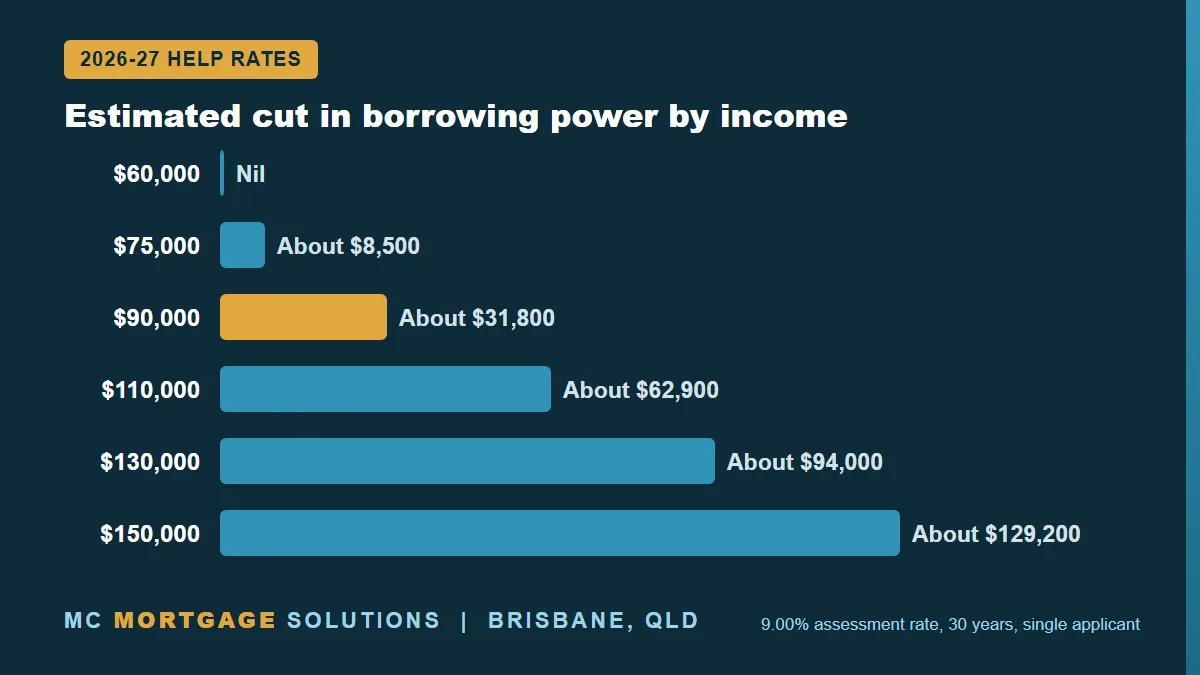
The same method estimates a borrowing power cut of nil at $60,000 and about $129,200 at $150,000. The table applies the 2026-27 rates and the six assumptions above, and it rounds the cut to the nearest $100.
| Repayment income | Annual HELP repayment | Monthly HELP repayment | Estimated cut in borrowing power |
|---|---|---|---|
| $60,000 | Nil | Nil | Nil |
| $75,000 | $820.80 | $68.40 | About $8,500 |
| $90,000 | $3,070.80 | $255.90 | About $31,800 |
| $110,000 | $6,070.80 | $505.90 | About $62,900 |
| $130,000 | $9,076.11 | $756.34 | About $94,000 |
| $150,000 | $12,476.11 | $1,039.68 | About $129,200 |
The cut grows faster than income. The repayment rises with every extra dollar above the threshold.
What the Worked Example Leaves Out
The borrowing power example leaves out each lender’s own policy, so your result will differ. Each lender sets its own assessment rate, living expense test and method for counting HELP repayments.
Your deposit, other debts and the loan to value ratio can also set a lower limit than serviceability does. Treat the table as a guide to the size of the effect. It is not an approval estimate.
Check Your HECS Debt Home Loan Position With a Brisbane Mortgage Broker
A Brisbane mortgage broker can check your HECS debt home loan position against more than one lender’s policy before you apply. MC Mortgage Solutions has access to 30+ lenders and 200+ loan products from its Manly office, and the service costs you nothing because lenders pay MC. Tell us your income, HELP balance and target price, and we will show you how lenders treat the repayment. Read about First Home Buyer Loans Brisbane or call 07 3893 3208. Australian Credit Licence 394061. Call 07 3893 3208 | Book a 15-minute call
When Can a Lender Leave Out Your HECS-HELP Repayment?
A bank can leave out your HECS-HELP repayment when it expects you to clear the debt soon, and APRA treats a payoff within 12 months as a reasonable guide. APRA (2025) says exceptions of that kind “would not be unreasonable” for debts that clear within 12 months.
The 12 Month Guide in APRA’s Guidance
APRA’s 12 month guide is an anchor for banks, not a rule that forces them to leave the repayment out. Each bank sets the exception in its own lending policy, and APRA expects those exceptions to stay prudent and limited.
APRA (2025) explains the logic. A borrower who will repay a HELP debt in five years carries a different risk from one who will repay it within 12 months. Banks report loans approved this way to APRA as exceptions.
Non-bank lenders sit outside APRA’s rules (APRA April 2026), so their policies can differ from a bank’s.
What 12 Months Means in Dollars
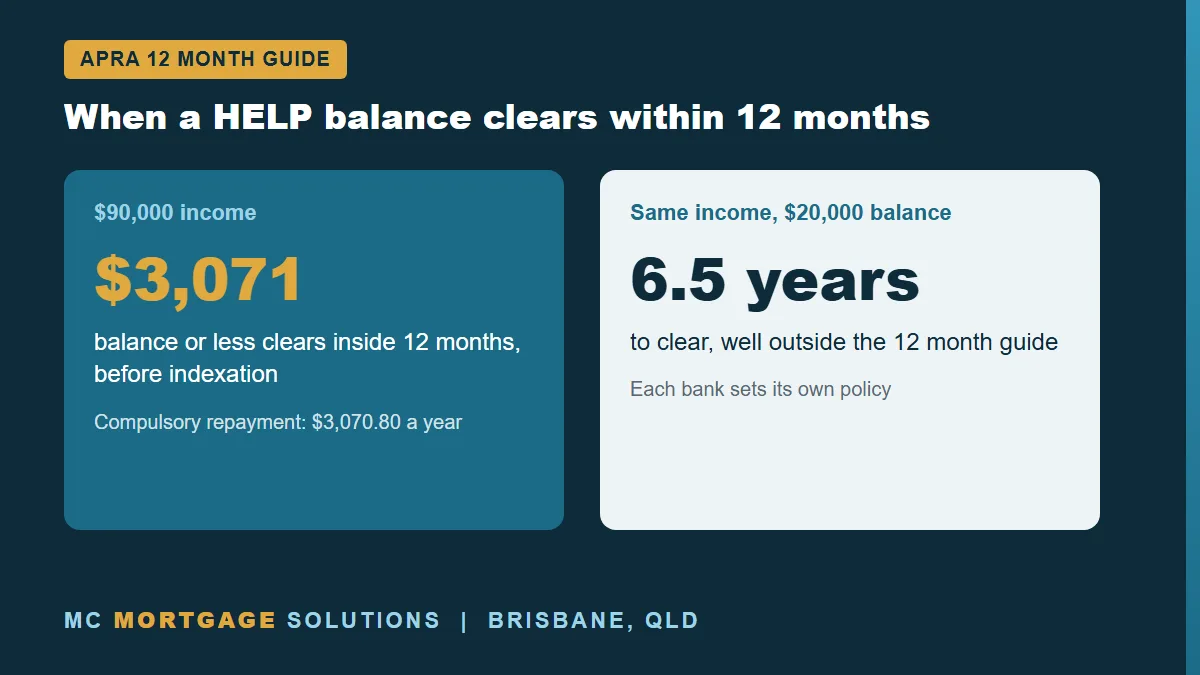
At a $90,000 income, a HELP balance of about $3,071 or less clears within 12 months, before indexation. The compulsory repayment at that income is $3,070.80 a year, so a balance at or below that figure repays inside the year.
A $20,000 balance at the same income takes about 6.5 years to clear, so it falls well outside the guide. The ATO (2026) applied 2.8% indexation on 1 June 2026 to the part of the debt unpaid for more than 11 months. Confirm your balance through ATO online services in myGov on the day you apply.
Should You Pay Off HECS-HELP Before You Apply for a Home Loan?
A partial voluntary repayment does not lower your compulsory HELP repayment, so it does not lift your borrowing power on its own. It helps only when it clears the whole debt or brings the balance inside a lender’s near-term exception.
Voluntary Repayments Do Not Lower the Compulsory Repayment
Voluntary HELP repayments do not reduce or offset your compulsory repayment. StudyAssist (2026) states that voluntary repayments sit on top of the compulsory amount and are not refundable.
They cut the balance once the ATO processes them. A voluntary repayment made before 1 June also lowers the amount that indexation applies to. The one-off 20% cut on balances at 1 June 2025 (ATO 2026) shortened how long repayments last, and the monthly repayment still follows your income.
Weighing Deposit Savings Against the HELP Balance
Clearing a HELP debt with deposit savings trades deposit for borrowing power. In the $90,000 example, a $20,000 payment that clears a $20,000 balance removes a $255.90 monthly commitment, worth about $31,800 of borrowing power, and it takes $20,000 out of your deposit.
Whether that trade pays depends on the purchase price, the loan to value ratio and the lender. Run both versions through a pre-approval before you move any savings.
Get a Home Loan Pre-Approval That Tests Your HECS-HELP Debt
A home loan pre-approval tests your HECS-HELP debt against a lender’s real policy, which an online calculator cannot do. MC Mortgage Solutions can run a pre-approval with your HELP balance in place and again with the debt cleared, so you see the difference in dollars. Start with Brisbane Home Loan Pre-Approval or call 07 3893 3208. Australian Credit Licence 394061. Call 07 3893 3208 | Book a 15-minute call
Frequently Asked Questions About HECS-HELP Debt and Home Loans
Does HECS debt affect your home loan borrowing power?
Yes, HECS-HELP debt affects borrowing power when your repayment income is above $69,528, because lenders usually count the compulsory repayment. At a $90,000 income that repayment is $255.90 a month. Below the threshold the repayment is nil.
Does a bigger HECS-HELP balance lower my borrowing power more?
No, a bigger balance does not raise your repayment, because your income sets it (APRA 2025). A $40,000 balance and an $80,000 balance give the same repayment at the same income. The balance decides how long the repayments last.
Can I get a home loan with a HECS-HELP debt?
Yes, you can get a home loan with a HECS-HELP debt, because ASIC and APRA guidance lets lenders approve borrowers who owe one. Each lender runs its own serviceability test, so the amount you can borrow differs between lenders. A broker can compare lender policies before you apply.
Will a lender ignore my HECS-HELP debt if I am nearly paid off?
Some banks may, because APRA says leaving out the repayment is not unreasonable when the debt clears within 12 months. Each bank sets its own policy, and non-bank lenders sit outside APRA’s rules. At a $90,000 income, a balance of about $3,071 or less clears within 12 months, before indexation.
Does HECS-HELP debt count in the debt-to-income ratio?
No, not in the ratio banks report to APRA, because that definition has excluded HELP debt since 30 September 2025. HELP repayments still count in the serviceability test. Ask your lender how it treats the debt in its own policy.
Do voluntary HELP repayments increase my borrowing power?
Not by lowering your compulsory repayment, because voluntary repayments do not reduce it (StudyAssist 2026). They cut the balance, which helps only when you clear the debt or reach a lender’s near-term exception. Check the lender’s rule before you pay extra.
What is the HECS-HELP repayment threshold for 2026-27?
The 2026-27 minimum repayment income is $69,528 (ATO 2026). Above it you pay 15 cents per dollar up to $129,717, then $9,028 plus 17 cents per dollar up to $186,050. At $186,051 and over you pay 10% of your total repayment income.
Do a net rental loss or super salary sacrifice change my HELP repayment?
Yes, both add to repayment income, so they can raise your repayment. The ATO (2026) counts total net investment loss, including net rental losses, and reportable super contributions. A higher repayment income can move you into a higher band.
Do VET Student Loans and other study loans count the same way?
The ATO (2026) applies one 2026-27 repayment table to HELP, VET Student Loans, Student Financial Supplement Scheme loans, Student Start-up Loans, ABSTUDY Student Start-up Loans and Australian Apprenticeship Support Loans. APRA’s 12 month guidance covers HELP debt specifically, so ask a lender how it treats other study loans.
Did the 20% HELP debt cut change how much I can borrow?
The 20% cut lowered HELP balances on 1 June 2025, but your repayment still follows your income (APRA 2025). The cut shortens how long you repay. It may also help a balance fall inside a lender’s near-term exception.
Where to Go Next
These MC pages cover the next steps after a HECS debt home loan check.
- First Home Buyer Loans Brisbane
- Brisbane Home Loan Pre-Approval
- Help to Buy vs 5% Deposit Scheme vs Guarantor (QLD 2026)
- QLD First Home Buyer Stamp Duty and Concessions (2026)
Sources for the HECS-HELP facts in this post.
- ATO, study and training loan minimum repayment income and rates
- ATO, study and training loan indexation rates
- ATO, study and training loans what's new
- StudyAssist, loan repayments
- StudyAssist, indexation of 2.8% on 1 June 2026
- APRA, clarifying the treatment of HELP debt obligations
- APRA, response to consultation on HELP debt obligations
- ASIC, updated guidance on student loan commitments
- APRA, submission to the Senate Select Committee on Productivity (April 2026)
General information only. It is not credit advice and does not take your personal situation into account. Repayment thresholds, indexation and lender policies change, so ask us to check current figures before you apply. MC Mortgage Solutions, Australian Credit Licence 394061 (ACN 128 555 902), 138 Kingsley Tce, Manly QLD 4179, 07 3893 3208 and 1300 633 667.