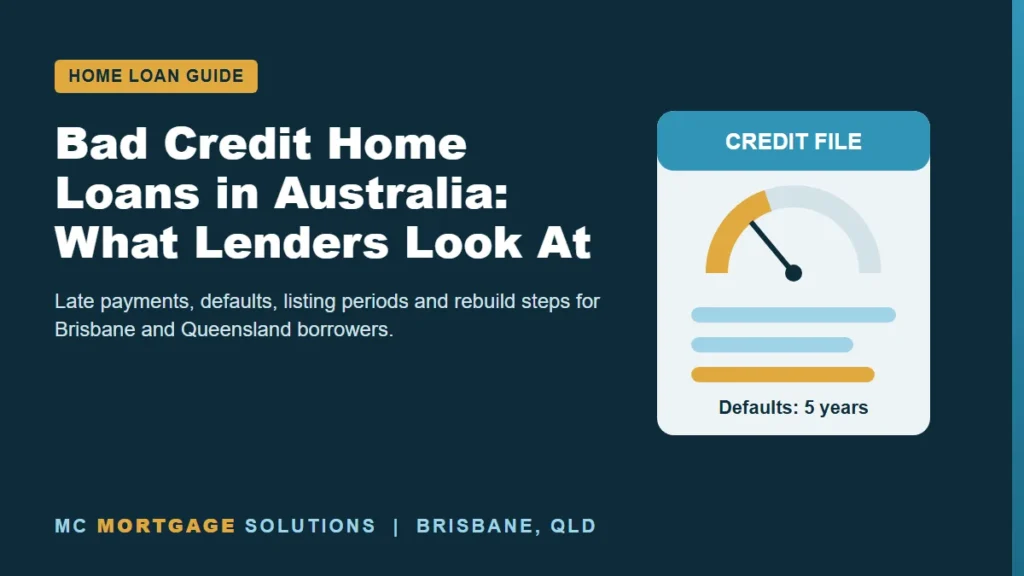
Bad credit home loans are available in Australia, but no lender or broker can promise approval before a lender assesses your whole credit report. A lender looks at your defaults, your repayment history, your recent credit applications and your ability to repay the new loan. Each lender decides how to meet the responsible lending laws, so the same file can get different answers.
A default stays on your credit report for 5 years, even after you pay it. A late payment stays for 2 years.
Neither entry shuts the door on its own. Both can change which lender will look at your application.
The sections below cover what counts as bad credit, how defaults and late payments differ, what lenders check beyond your credit score, how banks and non-bank lenders compare and five steps to rebuild your credit. MC Mortgage Solutions, mortgage broker serving Brisbane‘s Bayside, Redlands Coast and Brisbane East, wrote the post from OAIC, Moneysmart, ASIC and APRA sources checked in November 2026.
What Counts as Bad Credit on a Home Loan Application?
Bad credit on a home loan application means negative entries on your credit report, such as a default, a late payment, a court judgment or a bankruptcy. Your credit report records what you borrowed, how you repaid it and which lenders checked your file. Moneysmart (2026) lists personal details, credit products held in the last two years, repayment history, hardship information, defaults, credit applications, bankruptcies and credit report requests.
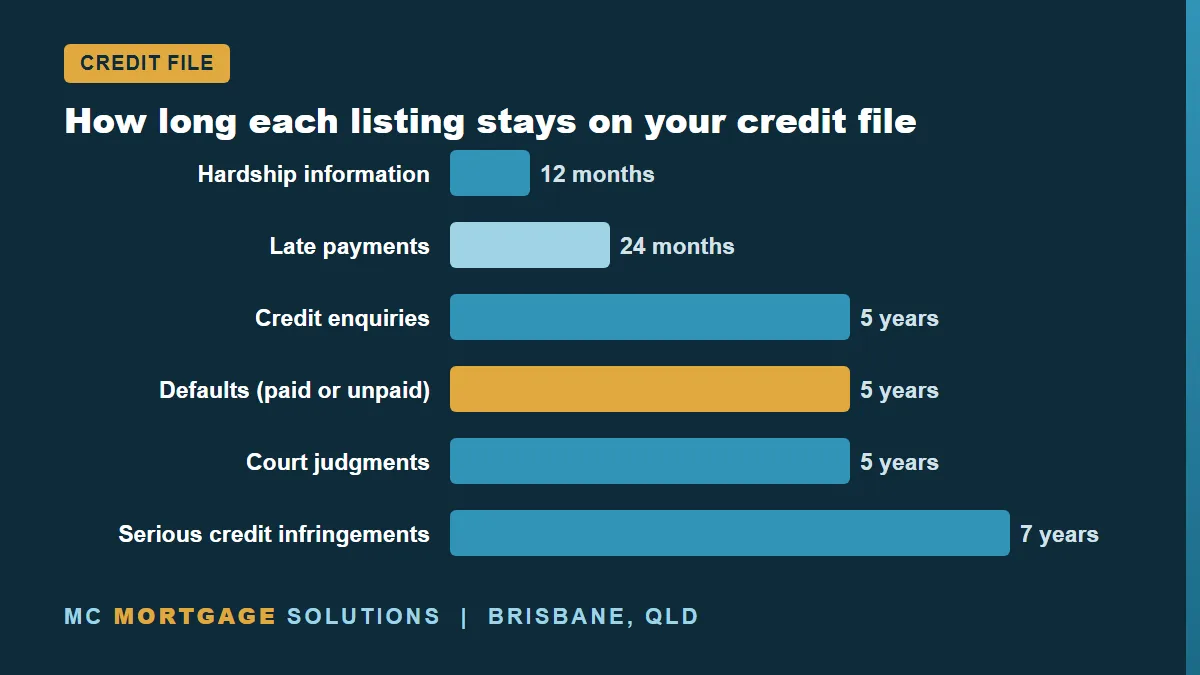
The Privacy Act sets how long each entry stays on your credit report, and the Office of the Australian Information Commissioner (OAIC, 2023) publishes the periods. The table shows the ones that matter for a home loan application.
| Credit report entry | How long it stays |
|---|---|
| Late payment (repayment history) | 2 years |
| Financial hardship information | 1 year |
| Default | 5 years, or 7 years for a clearout |
| Credit enquiry | 5 years |
| Court judgment | 5 years |
| Serious credit infringement | 7 years |
| Bankruptcy and debt agreement | The later of two periods, explained below |
Defaults on a Credit Report
A default is a listing that a credit provider adds when a payment is at least 60 days overdue and the overdue amount is $150 or more. According to the OAIC (2023), the provider must send you two notices first, with the second at least 30 days after the first, and then wait at least 14 days before it lists the default.
A default then stays on your credit report for 5 years. A clearout, which is when the provider cannot contact you, stays for 7 years (Moneysmart 2026).
Late Payments and Repayment History
A late payment is a repayment that you make more than 14 days after the due date, and it goes into your repayment history. The OAIC (2023) says the entry appears as a number from 0 to 7, which is the age in months of your oldest missed payment.
The entry stays on your credit report for 2 years. The credit provider does not need to send you a written notice before it lists the missed payment.
Credit Enquiries and Applications
Each credit application adds an enquiry to your credit report, and the enquiry stays there for 5 years. The OAIC (2023) puts credit enquiries in the same 5-year group as defaults and court judgments. Too many in a short time can also lower your credit score, says Moneysmart (2026).
Bankruptcy, Debt Agreements and Court Judgments
Bankruptcy, a debt agreement and a court judgment each stay on a credit report for a set period. The OAIC (2023) lists a court judgment at 5 years and describes bankruptcy and debt agreements as the later of two periods. The Law Handbook (2020) gives the bankruptcy periods as 5 years from the date of bankruptcy or 2 years from a delayed discharge, whichever is later.
How Do Defaults and Late Payments Differ on a Credit Report?
A default is a formal listing for a debt that is at least 60 days and $150 overdue, while a late payment is a repayment that arrives more than 14 days after the due date. The table compares the two entries using the OAIC (2023) and Moneysmart (2026) rules.
| Feature | Late payment | Default |
|---|---|---|
| Trigger | Payment made more than 14 days after the due date | Payment overdue 60 days or more, for $150 or more |
| Notice before listing | No written notice needed | Two notices, then a wait of at least 14 days |
| Where it appears | Repayment history, shown as a number from 0 to 7 | Default listing on your credit report |
| How long it stays | 2 years | 5 years, or 7 years for a clearout |
| After you pay | The report records when you made the payment | The listing stays and shows that you paid |
Both entries sit on the same report, so a lender can see them side by side. A default carries a longer retention period and a stricter listing process than a late payment.
Does Paying a Default Remove It From Your Credit Report?
No, paying a default does not remove it from your credit report, but the listing updates to show that you paid. Both the OAIC (2023) and Moneysmart (2026) say the listing stays for its full period.
Correct information stays too, even when it is negative. You can only change what is wrong.
Can a Hardship Arrangement Appear on Your Credit Report?
Yes, a financial hardship arrangement can appear on your credit report, and it stays for 12 months. The arrangement does not affect your credit score, and you show as up to date while you keep to it (Moneysmart 2026). A lender cannot list a default while it decides your hardship request, or until 14 days after it refuses the request (OAIC 2023).
A lender can still list a default if it reasonably believes you made the same request in the previous 4 months (OAIC 2023).
What Do Lenders Check Besides Your Credit Score on a Bad Credit Home Loan?
Lenders check your credit report, your income, your expenses and your debts, because the National Credit Act requires them to inquire about and verify your financial situation. The Australian Securities and Investments Commission (ASIC, 2026) lists three duties. A lender makes reasonable inquiries about your financial situation, requirements and objectives, takes reasonable steps to verify that situation and assesses that the loan is not unsuitable for you.
Each credit licensee decides how it will meet those duties, so lender credit policies differ.
Your Credit Score and Credit Report
Your credit score is a number from 0 to 1,000 or 0 to 1,200, depending on the credit reporting agency, and it comes from your credit report. Moneysmart (2026) says the score reflects the amount you have borrowed, the number of applications you have made and whether you pay on time. Credit providers and mortgage insurers can both access your credit report.
Income, Expenses and the Serviceability Buffer
Serviceability is the lender’s test of whether you can afford the repayments, and banks add a buffer to the interest rate when they run it. The Australian Prudential Regulation Authority (APRA, 2026) kept the mortgage serviceability buffer at 3 percentage points on 28 May 2026. Canstar (2026) says banks add that 3 percentage points to your interest rate when they test whether you can afford a loan.
A bank tests you at a higher rate than the one you would pay.
MC Mortgage Solutions sums up the checks as income, credit history, existing debts and deposit.
Do Banks or Non-Bank Lenders Approve Bad Credit Home Loans?
Both banks and non-bank lenders can assess bad credit home loans, and each decides under its own credit policy whether to approve one. Canstar (2026) says non-bank lenders can be more flexible and that some specialise in borrowers with low credit scores. The table compares the two lender types using Canstar (2026) and APRA (2026).
| Feature | Bank (ADI) | Non-bank lender |
|---|---|---|
| Banking licence | Yes, an authorised deposit-taking institution licence | No |
| Takes customer deposits | Yes | No |
| Supervised by APRA | Yes | No |
| 3 percentage point serviceability buffer | Applies | Not required |
| Australian Credit Licence and responsible lending rules | Apply | Apply |
What Is a Non-Bank Lender?
A non-bank lender is a lender without a banking licence that still offers mortgages and other credit. It cannot take customer deposits, so it funds loans through investors, corporate bonds or mortgage-backed securities (Canstar 2026). ASIC regulates non-bank lenders, and they must hold an Australian Credit Licence, according to Canstar (2026).
Do Non-Bank Lenders Charge Lower Rates?
Canstar’s database shows lower average variable rates at non-bank lenders, at 6.25% a year against 6.67% for banks on 24 August 2026. Those averages cover owner-occupier loans with an 80% LVR and a $600,000 balance, not bad credit loans, so they do not show what a borrower with a default would pay. Canstar (2026) recommends comparing the comparison rate, because a lower interest rate can cost more once you add fees.
What a Mortgage Broker Does With a Bad Credit Home Loan
A mortgage broker compares lenders for you and lodges one application with the lender whose policy fits your credit report, and that lender makes the final credit decision. ASIC (2026) assigns the preliminary assessment to the person giving credit assistance and the final assessment to the credit provider, so no broker can guarantee approval.
MC Mortgage Solutions compares 30+ lenders and 200+ loan products from its Manly office. It sends one well-matched application instead of stacking enquiries on your file.
Talk Through Your Credit Report With a Brisbane Mortgage Broker
MC Mortgage Solutions can review your credit report and tell you which lender policies suit your situation before anything goes on your credit file. Start with a free, no obligation assessment through Brisbane Home Loan Pre-Approval, or call 07 3893 3208. Australian Credit Licence 394061 (ACN 128 555 902). Call 07 3893 3208 | Book a 15-minute call
How to Rebuild Your Credit Before You Apply for a Home Loan
To rebuild your credit before you apply for a bad credit home loan, pay bills on time, keep card balances low, fix errors, limit new applications and check any credit repair company. Moneysmart (2026) describes this as a steady process where small, consistent steps make a real difference. Rebuilding does not erase correct negative entries, which stay for their full retention period.
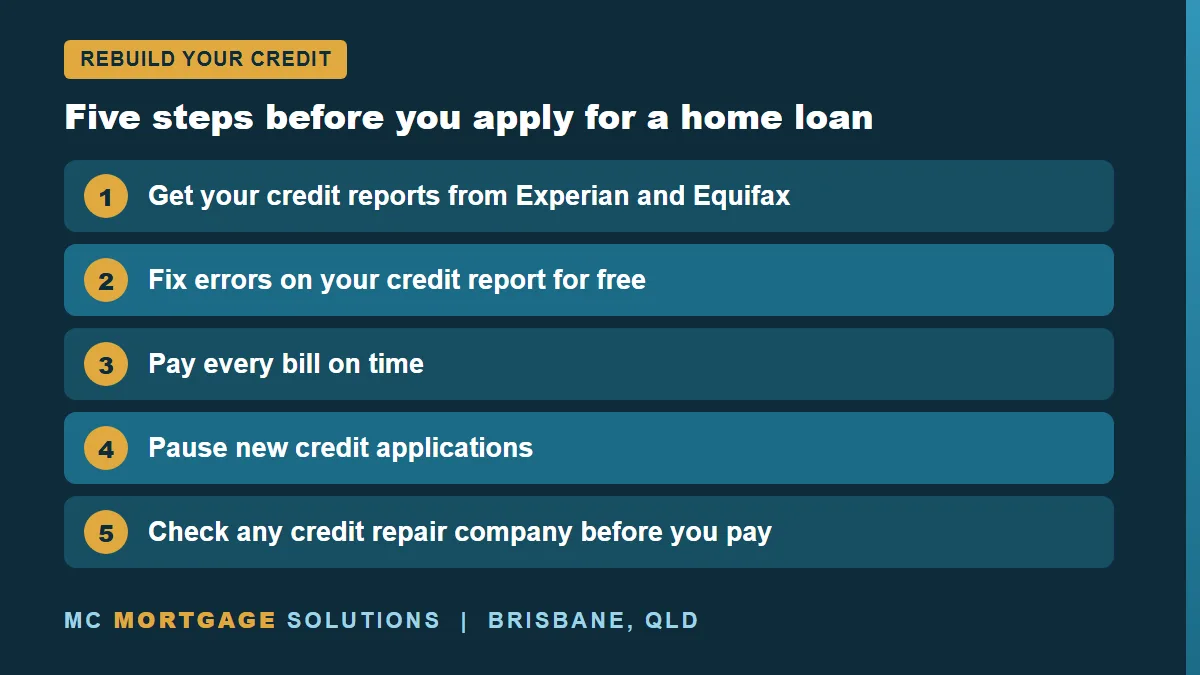
Step 1, Get Your Credit Reports From Experian and Equifax
Request your credit report from both Experian and Equifax, because the two credit reporting agencies can hold different information. Moneysmart (2026) says you can get a free copy every 3 months. The OAIC (2023) adds that you can also get a free copy if a lender refused you credit in the past 90 days.
Check that every loan and debt on the report is yours and that your name, date of birth and address are correct (Moneysmart 2026).
Step 2, Fix Errors on Your Credit Report for Free
Contact the credit reporting agency or the lender to fix an error on your credit report, and the correction costs nothing. Moneysmart (2026) lists four errors you can fix, a debt shown twice, a wrong debt amount, a lender listing a default during a dispute and a payment wrongly marked 60 days overdue. The Australian Financial Complaints Authority offers free, independent dispute resolution when you cannot reach agreement.
Step 3, Pay Every Bill on Time
Pay every bill on time, because a late payment goes into your repayment history on your credit report for 2 years. Moneysmart (2026) suggests reminders or direct debits to stay on track, and a low card balance so you do not use most of your limit. Talk to your lender straight away when repayments get out of control, because early action can stop a small problem from becoming a big one (Moneysmart 2026).
Step 4, Pause New Credit Applications
Pause new credit applications while you rebuild your credit, because each application adds an enquiry that stays on your credit report for 5 years. Too many in a short time can lower your score. Buy now pay later applications also trigger a credit check (Moneysmart 2026).
Step 5, Check Any Credit Repair Company Before You Pay
Check that a credit repair company holds an Australian Credit Licence or acts as a credit representative on ASIC’s website before you pay it anything. Moneysmart (2026) says you do not need to pay anyone to fix errors on your credit report, and unpaid credit repair fees can lead to a new default. A company can only ask the credit reporting agency to remove wrong information, not correct negative entries (Moneysmart 2026).
Check Your Bad Credit Home Loan Options Before You Apply
MC Mortgage Solutions assesses your credit report, income, debts and deposit and tells you which lender policies suit your situation before it lodges anything. Read about Home Loans Brisbane or call 07 3893 3208. Australian Credit Licence 394061 (ACN 128 555 902). Call 07 3893 3208 | Book a 15-minute call
Frequently Asked Questions About Bad Credit Home Loans
Can you get a home loan with bad credit in Australia?
Yes, you can apply for a home loan with bad credit, but no lender or broker can guarantee approval. ASIC (2026) requires every credit licensee to inquire about and verify your financial situation, so the lender assesses your whole application. Canstar (2026) says some non-bank lenders specialise in borrowers with low credit scores.
How long does a default stay on your credit report?
A default stays on your credit report for 5 years, or 7 years in the case of a clearout. Moneysmart (2026) says the listing remains after you pay and shows that you paid it.
Can a lender see a default I have already paid?
Yes, a lender can see a paid default, because the listing stays on your credit report and shows that you paid it. The OAIC (2023) says the credit provider updates the listing to show the payment. The default still leaves the report only at the end of its retention period.
How long do late payments stay on your credit report?
Late payments stay on your credit report for 2 years as part of your repayment history. The OAIC (2023) counts a payment as missed when you make it more than 14 days after the due date. The entry shows as a number from 0 to 7.
What credit score do you need for a home loan?
Moneysmart, the OAIC and ASIC publish no minimum credit score for a home loan. Credit scores run from 0 to 1,000 or 1,200 depending on the agency, and a higher score means a lender sees you as less risky (Moneysmart 2026). Ask the lender or your broker which policy applies to your application.
Do non-bank lenders approve bad credit home loans?
Some non-bank lenders approve bad credit home loans, and Canstar (2026) says some specialise in borrowers with low credit scores. Non-bank lenders do not have to apply APRA’s 3 percentage point serviceability buffer, according to Canstar (2026). Each still applies its own credit policy to your file.
Does applying with several lenders hurt your credit?
Yes, each credit application adds an enquiry that stays on your credit report for 5 years. Moneysmart (2026) says too many applications in a short time can lower your credit score. Ask your broker to check lender policy before you apply.
How do I get a free copy of my credit report?
Request a free copy of your credit report from Experian and Equifax, which you can do every 3 months. The OAIC (2023) says you also get a free copy if a lender refused you credit in the past 90 days or a credit reporting agency corrected your report. Moneysmart (2026) says the two agencies can hold different information, so request both.
Do I need a credit repair company to fix my credit report?
No, you do not need a credit repair company to fix errors on your credit report, because you can ask for corrections yourself for free. Moneysmart (2026) says credit repair companies may charge high fees and unpaid fees can cause a new default. Check that any company you use holds an Australian Credit Licence or acts as a credit representative on ASIC’s website.
Can you get a bad credit investment property loan?
Yes, you can apply for an investment property loan with bad credit, and the credit reporting rules apply to it. The OAIC (2026) counts credit to buy residential property for investment as consumer credit. Each lender applies its own credit policy to investor applications, so ask before you apply.
Sources
- OAIC, What stays on a credit report
- OAIC, Repayment history and defaults
- OAIC, What is a credit report?
- OAIC, Credit reporting terms
- Moneysmart, Credit scores and credit reports
- Moneysmart, Credit repair
- ASIC, Responsible lending
- APRA, macroprudential policy settings, 28 May 2026
- Canstar, Home loans from non-bank lenders
- Law Handbook (SA), Accessing and changing information on credit report
General information only. It is not credit advice and does not take your personal situation into account. Credit reporting rules and lender policies change, so ask us to check current criteria before you apply. MC Mortgage Solutions, Australian Credit Licence 394061 (ACN 128 555 902), 138 Kingsley Tce, Manly QLD 4179, 07 3893 3208 and 1300 633 667.